Aurubis far advanced in car battery recycling development
"Batteries contain very valuable substances, all of which are recyclable"
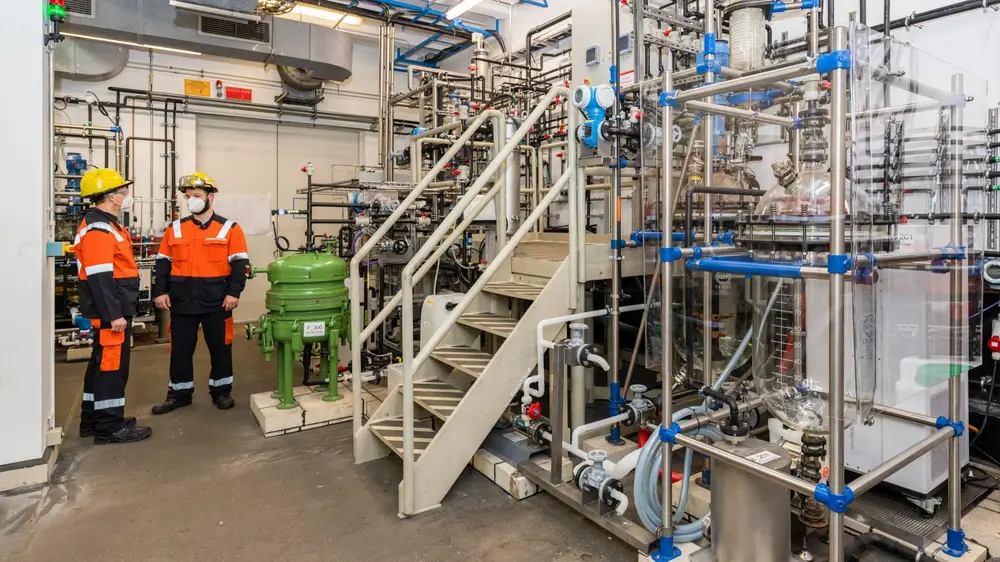
For over a year, Aurubis, a large supplier of non-ferrous metals, has been researching with recovering lithium and other metals from used lithium-ion batteries in a pilot plant in Hamburg. The goal is to arrive at a process, which can efficiently recover lithium, nickel, cobalt, manganese and graphite from the black mass left over after dismantling and shredding the batteries of electric cars.
Recycling efforts to meet rising demand
Tests are progressing well. Meanwhile, Aurubis plans to build a demonstration plant that will come on line in the first half of 2024. The company is also studying the feasibility of building a full-scale plant that should come on line in a yet to be determined location in the coming years.
The company owns a network of smelters and refineries in Europe, where it produces copper, copper alloys, nickel, tin, lead, zinc, selenium and tellurium from metal concentrates derived from ores and further from scrap and recycled metallic materials. For example, Aurubis is one of the world's largest copper recyclers. It supplies about one million tons of copper cathodes per year as well as, among other things, wire rod and continuous cast shaped parts that can be rolled elsewhere. It also produces precious metals, such as gold, silver and platinum.
"Thanks to the energy transition, copper for electric cars, charging stations and cables is in high demand"
"Copper demand is growing rapidly," said Adalbert Lossin, head of research and development at Aurubis. "Thanks to the energy transition, copper for electric cars, charging stations and cables is in high demand. Because of the growth in the number of electric cars, the demand for electric batteries is also increasing and with it lithium, which we do not yet have in our portfolio. An electric car contains 5 to 10 kilograms of lithium. We now have a technology, which allows us to recover not only non-ferrous metals but also lithium from the black mass coming from old Li-ion batteries."
In current semi-precious and precious metal production, lithium ends up as a non-precious metal in the iron silicate byproduct. This also happens in existing recycling processes. Lossin: “Using hydrometallurgy, we can also recover the lithium, which will allow us to meet the increasing demand for lithium for lithium-ion batteries.”
The process steps
At Aurubis, the recycling of lithium and other metals proceeds as follows:
1. First, the lithium is separated from the black mass by dissolving or leaching it, as it is called in hydrometallurgy. The rest of the metals and other substances remain in the black mass.
2. After filtration, the dissolved lithium is converted into lithium phosphate, lithium carbonate or lithium sulfate. Aurubis is figuring out which of these products is of most interest.
3. The remaining black mass is leached again, this time to dissolve nickel, cobalt and manganese.
4. After a second filtration, graphite is recovered from the remaining black mass using flotation. In this process, the graphite particles attach to air bubbles rising in the slurry to which surfactants have been added. The particles collect in the foam on the surface. This is a well-known process used in mining to separate minerals.
5. The solution containing nickel, cobalt and manganese is then purified of copper, iron and fluorine.
6. Cobalt and manganese are then removed from the purified solution and separated, resulting in the intermediate products cobalt sulfate and manganese oxide.
7. Finally, nickel is separated and converted into the intermediate product nickel sulfate.
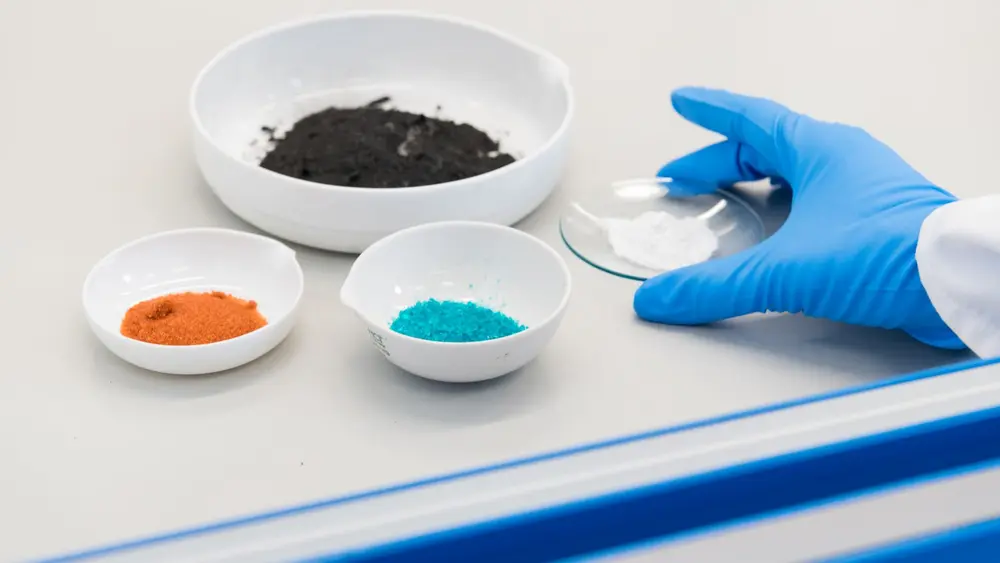
Aurubis can market these metal compounds, but is also looking at the attractiveness of upgrading them to metal products.
"There are many companies, including large corporations and start-ups, exploring how best to recover lithium. Our process is unique because we already extract the lithium at the first step in the process," Lossin explained.
"We also differentiate ourselves in that this process produces an intermediate lithium product that is essentially free of fluorine," continued Leslie Bryson, Head of Hydrometallurgy in Research & Development at Aurubis. "This is important because fluorine, derived from batteries, otherwise interferes with further processing of lithium into products such as lithium carbonate."
Flotation also allows for greater than 80% percent of the graphite to be recovered. In pyrometallurgical processes, where metals are recovered by heating, the graphite burns, leading to higher CO2 emissions.
"Our process also works with non-pyrolyzed black mass, which is dried at low temperature"
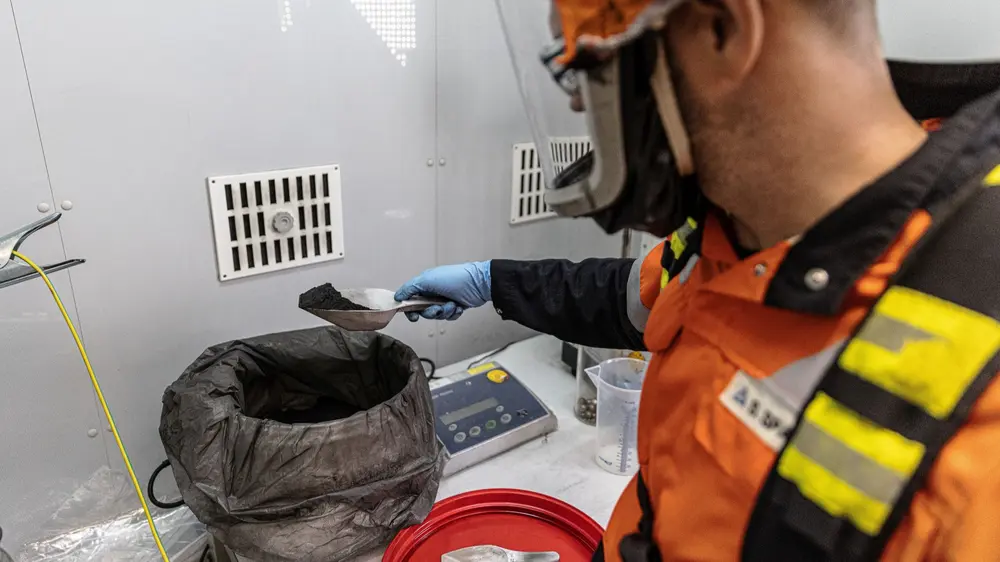
Batteries usually also contain liquid electrolyte and organic liquids, leaving a wet black mass after batteries are discharged and shredded. The companies, which collect and shred batteries, dry the black mass in two different ways. Some do so by pyrolysis (heating to more than 500 degrees Celsius with no supply of oxygen) and others by vacuum drying at a low temperature. In the latter, they collect the organic matter with condensation. Bryson: "We hear from the market, that some hydrometallurgical processes for recovering metals only work when all the organic matter has been removed. Our process also works with non-pyrolyzed black mass, which is dried at low temperature."
Fourth campaign in pilot plant
In October, the fourth campaign in the pilot plant began. "The core of the process, processing black mass, has remained essentially the same throughout. It appears to be quite robust. In the tests, we are mainly looking at the best way to extract the lithium. The pilot is not so much for scaling up the process as to achieve good mass and energy balances. This will provide criteria for process design, based on which we can then proceed to design and build an appropriately sized plant with greater insight and understanding," Bryson continued.
"Furthermore, we are investigating what the critical process steps in scaling up are. We are doing this in collaboration with Professor John van der Schaaf's group at Eindhoven University of Technology. A D.Eng student is investigating the possibilities for process intensification," Bryson adds.
Recycling market is growing rapidly
Lossin finds it difficult to predict how many batteries will become available for recycling in the coming years. "That depends on the increase in the number of electric cars over the next 10 years and the lifespan of batteries. Those in cars are expected to last eight to nine years. For sure, there will be huge numbers of batteries returning to the value chain for recycling. We focus on the so-called black mass and want to recycle the metals from it and supply them to manufacturers who turn them into new batteries."
Recycling metals is cheaper than extracting metals from ores, he notes. "In general, a recycling process requires less energy than processing ore into metal. Several studies have been done on that. We don't have exact data on that yet, but we are working on a life cycle assessment of our recycling process and how it plays out in the value chain. We have already done assessments for the metals in our portfolio, such as copper, for example. It is evident that recycled materials have a lower footprint than primarily produced ones," Lossin said.
"The only sustainable way to use battery materials, is to recycle both metals and other materials"
He points out, the recycling of batteries is necessary anyway. "Batteries contain many valuable materials. For example, an electric car contains 100 kilograms of copper, a third of which is in the batteries. It would be a shame not to reuse those materials, given the scarcity of raw materials and the environmental and climate impact of their extraction. "There is only one way to sustainably use the materials of batteries, and that is to recycle both metals and other materials," Lossin said.