BIORIZON - a SHARED RESEARCH center ON BIO-AROMATICS
knowledge of bio-aromatics taken to the next level
 Aromatics currently represent a world market of about 75-90 million tonnes on an annual basis, with a market value of about 95-115 billion euro. Aromatics are important building blocks for the chemical industry - no less than 40% of chemicals are aromatic. Because of climate change and exhaustion of the world’s natural resources, there is a increasing need for sustainable alternatives to petrochemical aromatics. Biorizon Shared Research Center has been co-creating technologies for the commercial production of bio-aromatics since 2013.
Aromatic compounds and applications
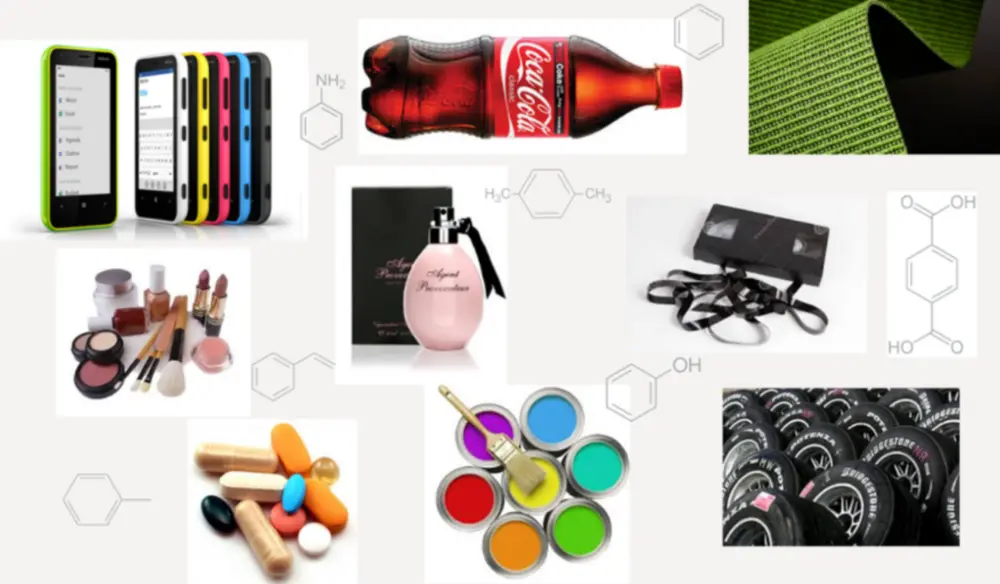
The global need for aromatics, a specific group of essential building blocks for the chemical industry increases each year with about 3-5%. Currently, this group of chemical building blocks represents a world market of about 75-90 million tonnes on annual basis with a market value of about 95-115 billion euro. Aromatic compounds are used as a resource for the production of plastics, coatings, additives, fibres, cosmetics, pharmacy and feed/food ingredients (vitamins, colourants, flavour).
Need for alternative resources for aromatics
Aromatic building blocks are traditionally isolated as a side-product during the refining and cracking of fossil oil. Due to its high price volatility on the one hand, and a change in the composition of product mixes from oil refineries on the other hand, the search for an alternative has increased. The use of biomass instead of fossil oil as an alternative feedstock not only results in less geopolitical dependence - and thus a more secure supply - but also in a greener chemical industry.
Biomass instead of fossil oil as feedstock for bio-aromatics results in less geopolitical dependence - more security of supply - and in the greening of the chemical industry
Market demand as initial driver
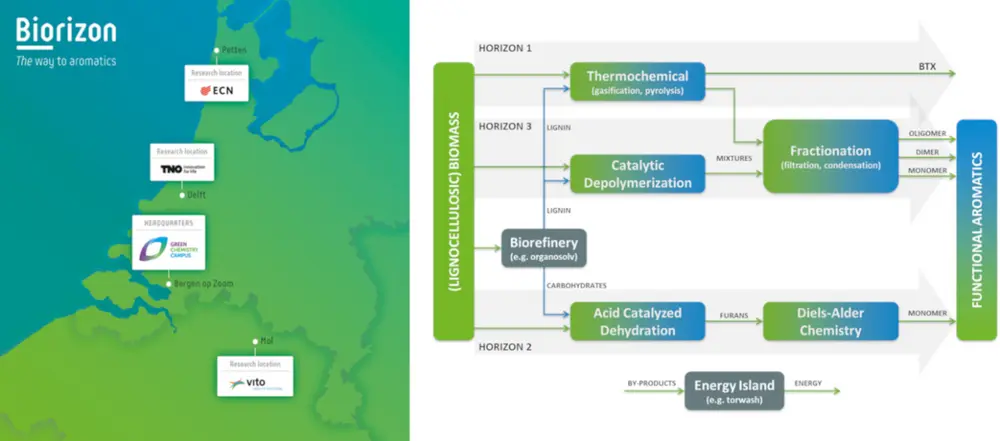
Brand owners like IKEA, Coca-Cola and LEGO force their upstream suppliers to contribute to delivering societal responsible consumer products to the market, placing sustainability high on the agenda. In the end, the chemical sector and end users request biobased aromatics, but of course for a competitive price. Market demand has been the initial driver to start and intensify the collaboration in the field of bio-aromatics, and to take the knowledge in the field of bio-aromatics to a next level. Combining research and budgets would reduce the risk of each participant and shorten market introduction. Therefore, Biorizon was founded in 2013 as a Shared Research Center clustering the expertise of several research organisations. Each of these coordinates one of three horizons in the Biorizon roadmap, pathways to get from lignin and carbohydrates to functional aromatics. This roadmap came about as a result of industrial involvement, visualized by the community members of Biorizon.
TNO-ET (TNO-EnergieTransitie - formerly known as 'ECN part of TNO') excels in the area of thermochemical conversions of biomass to bio-BTX aromatics and aromatic mixtures, as well as the area of high added value energy applications.
More recently, TNO-ET and VITO joined forces in lignin application development where TNO-ET brings in its technology development activities on lignin pyrolysis coupled with fractionated condensation.
TNO’s developments deliver sugar derived furans (including those derived from waste streams) and subsequently the production of drop-in chemicals and new functionalized bio-aromatics from these furan based precursors.
VITO delivers mixtures of lignin derivatives and functionalized aromatics issued from various lignin oils produced via different depolymerization technologies. These lignin-based mixes are subsequently used to synthesize new biobased polymers. In extension, biorefining lignocellulosic biomass is included in the program in order to deliver the required sugar and lignin feedstock materials for Biorizon developments towards biobased aromatics. The increasing complexity of biobased innovations drives organizations and companies to collaborate and develop together.